
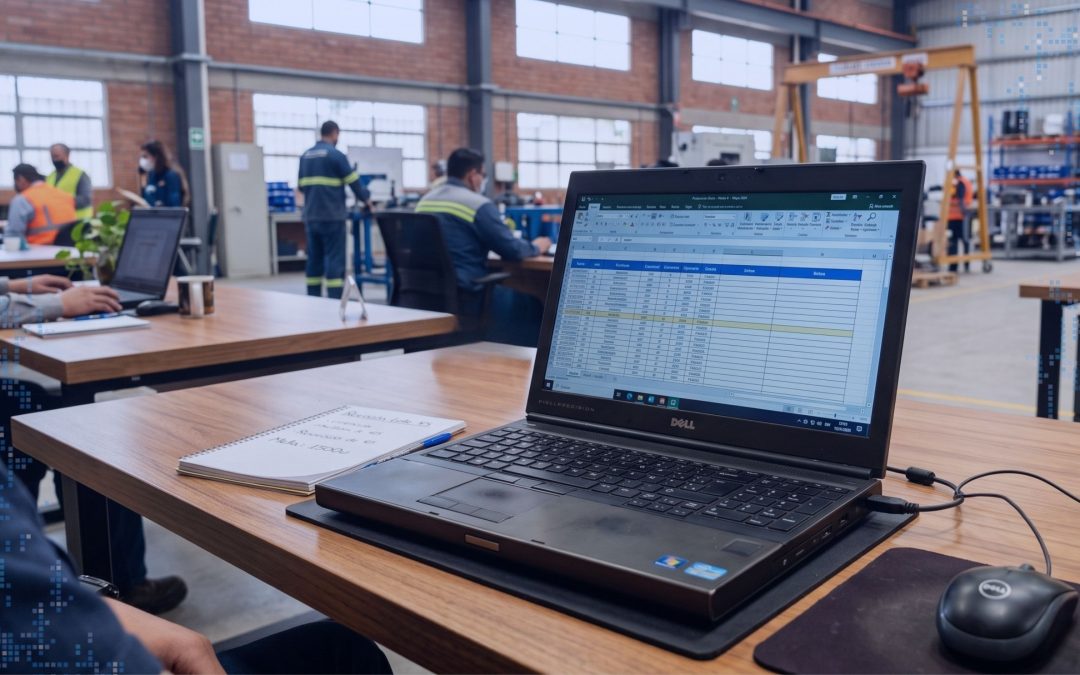
It's a common scene in many industrial plants: first thing in the morning, the operations team gathers around an Excel spreadsheet to review the previous day's numbers. They analyze downtime, production volumes, and failures. However, there's a crucial point to consider: they're analyzing the past.
Reviewing operations using an Excel spreadsheet is the industrial equivalent of performing an autopsy. The report tells you exactly what caused yesterday's productivity to "die," but it arrives when it's too late to do anything to correct it.
The Risk of Operating Solely with Excel
The problem with measuring a plant by hand isn't a lack of willingness on the part of the staff, but rather the very nature of the tool. Excel is excellent spreadsheet software, but it was never designed to be the nervous system of a production plant. When your process visibility relies on spreadsheets, your operation suffers from two major problems:
Lack of opportunity: You only find out that a temperature variable went out of control three or four hours after the defective batch occurred.
Lack of context: The numbers in a cell don't tell you why things are the way they are; they only show the final result of a chain of events that has already ended.
Human error: The silent enemy of manual data entry.
When a plant measures data "by hand," the reliability of the data is not absolute. The typical process depends on an operator taking a reading, noting it on a paper log, and eventually, someone else entering it into a shared file.
This workflow is the ideal scenario for human error:
- Approximate readings: Data approximated or rounded by the operator because the reading was taken late.
- Typical errors: An extra zero or a misplaced decimal point that completely alters the month's KPIs.
- Arguments over the numbers: Plant meetings devolve into debates about whether the data on the Excel spreadsheet is accurate or if "the operator made a mistake entering it," wasting valuable time that could be used to address the underlying problem.
By eliminating manual data entry, you eliminate mistrust in the information.
Modern SCADA: From real-time diagnosis to treatment
The strategic alternative to "autopsy" is real-time diagnosis, and that's precisely what a modern SCADA (Supervisory Control and Data Acquisition) system offers.
Unlike an Excel spreadsheet that passively waits for someone to input data, a SCADA system connects directly to the sensors, PLCs, and actuators on the production line.
The difference is striking: While Excel tells you how much you lost yesterday, SCADA alerts you to which variable is deviating right now, giving you the opportunity to adjust the process before it leads to losses or unscheduled downtime.
The Hidden Cost of Manual Measurement
Maintaining plant control through Excel spreadsheets has a hidden cost that is rarely factored into budgets but directly impacts the bottom line:
- Wasted man-hours: Time engineers and supervisors spend chasing paperwork and compiling reports, instead of optimizing processes.
- Reactive maintenance: Repairing equipment only after it has failed, instead of predicting failures through constant monitoring of critical variables.
- Loss of competitiveness: In a market that demands agility, a plant that makes decisions based on yesterday's data will always lag behind one that uses current data.
SIOS Connection: Frictionless Operational Clarity
At SIOS, as systems integrators and Operational Technology (OT) specialists, we help companies transition from paper and Excel to robust and automated information architectures; We design and implement SCADA systems that extract data directly from the factory floor, transforming it into clean, reliable, and, above all, timely KPIs. The goal isn't to give you more screens full of numbers, but rather the clarity you need to act at the precise moment.
Replacing Excel with an information system is a strategic decision to start optimizing your operations in real time.